中文
 English
 Español
 Русский
Current position:Home > News & Events > News
This Sheet Pile Wall Wasn’t Driven Along a River. It Went on a Coal Mine Dam Crest
This Sheet Pile Wall Wasn’t Driven Along a River. It Went on a Coal Mine Dam Crest.
On 24 September 2026, Ningxia Coal Industry Co., Ltd. (CHN Energy) issued a tender notice. The project is the Nanhu Reservoir Safety Reinforcement Works, on the border of Yanchi County and Lingwu City in Wuzhong, Ningxia Hui Autonomous Region, China. Two of the reinforcement items use the same method: adding plastic-steel sheet pile as a wave barrier along the upstream side of the water-retaining dam crest and the lakeside road crest, totalling 7,607 m and 27,259 m².
Why put a wave wall on the crest of a coal mine's reservoir dam?
01This lake is not natural. It stores mine water.
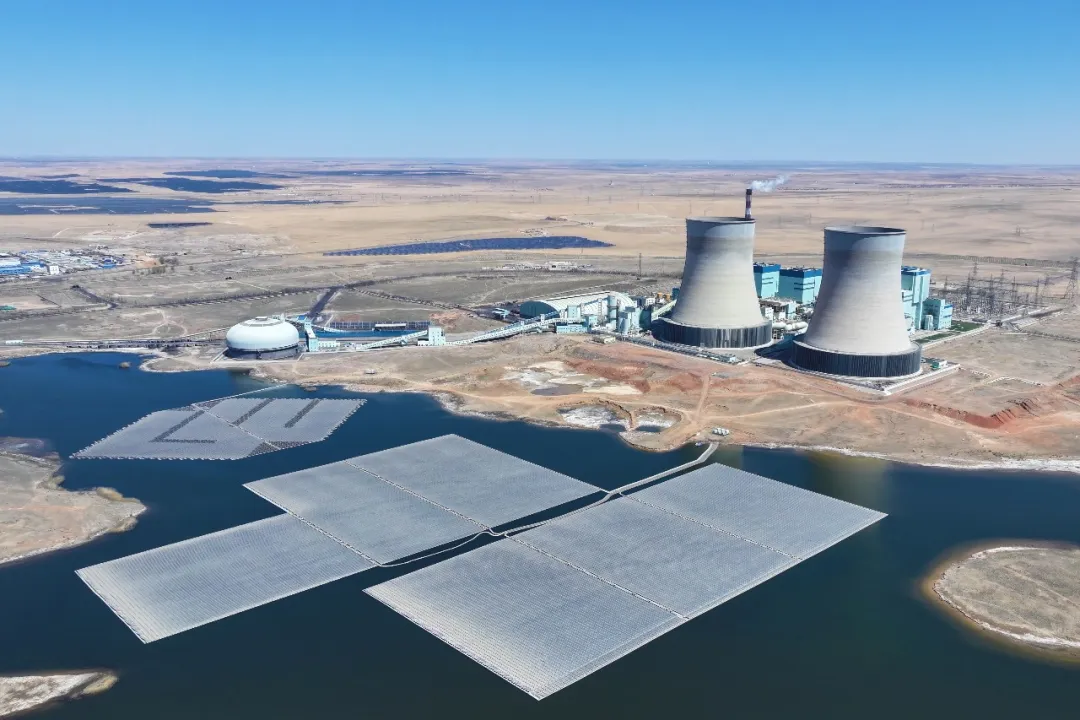
Nanhu lies on the border between Haizijing Village in Baitugang Township, Lingwu City, and Huiliuzhuang Village in Fengjigou Township, Yanchi County. It covers about 1,400 hectares and was not formed naturally.
Ningxia Coal Industry operates 13 pairs of producing coal mines in the Ningdong Coalfield, with an annual mine water inflow of 50 to 54 million m³. Mine water cannot be discharged into the Yellow River: what can be reused is reused, and the surplus is sent here for storage and ecological replenishment. The company has invested more than RMB 400 million in embankments, roads and monitoring facilities for the lake, which was listed in the second batch of the autonomous region’s important wetlands in 2020.
In normal operation the reservoir runs as designed: a storage capacity of 68.647 million m³ and a normal water level of 1,310 m.
This time is different. The notice states it plainly: a further 17.5 million m³ is to be discharged into Nanhu on top of the existing storage, raising temporary emergency storage capacity to 93.697 million m³ and the water level to 1,311.84 m. The reason is given in a single sentence: “Under the mandatory deadline for water discharge, natural evaporation cannot keep pace.”
Water keeps coming in. Treatment cannot keep up. Discharge to the Yellow River is not allowed. So it has to be stored first. When there is no room left, the level goes up.
1.84 m. On an earth dam that is already holding water, that is not a small number.
When the water rises, the dam crest gives first.
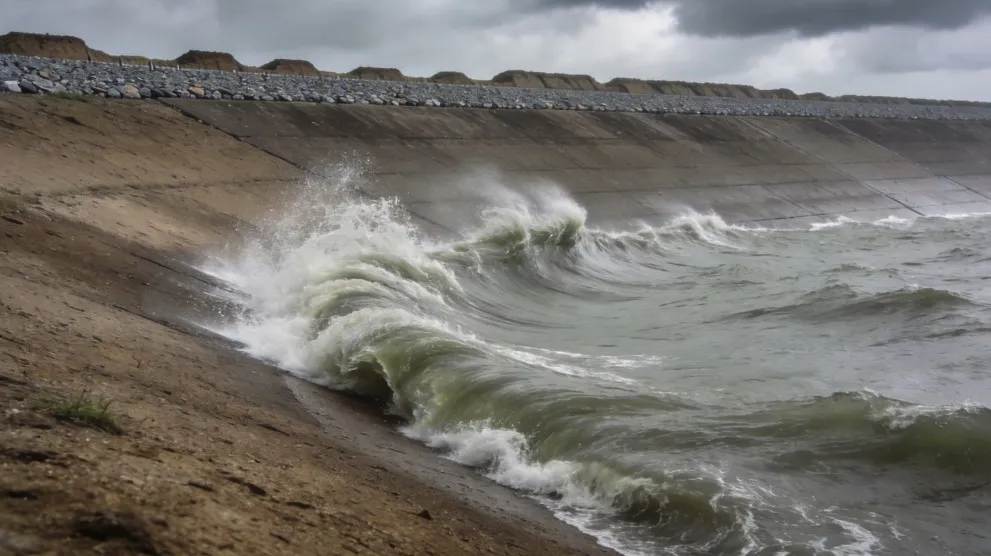
An earth dam crest was never designed to resist waves. It is a road, an inspection walkway, a gravel surface. It holds back water; it does not hold back waves. Raise the water level and the fetch stays the same, but wave run-up climbs with it. Water that breaks over the crest runs down the slope, scours the surface first, then the shoulder, and finally reaches the dam body.
There are two conventional answers. Raise the dam body: it needs fill material, land and time. Build a concrete wave wall: it is heavy, needs a foundation, costs more and takes longer.
Neither was workable here. The contract allows 254 calendar days, but the controlling schedule is compressed to 150 days, and it has to be split into two windows: 20 October to 30 November 2026, and 15 March to 30 June 2027. In between sits a Ningxia winter.
More to the point, the lake cannot be drawn down, and water has to keep going in.
A reservoir that is still filling, a winter that cannot be avoided, a schedule of 150 days. The options are few.
03Here, the sheet pile’s&nbp;job is wave resistance.
Each pile is 3.6 m in total height, with 1.2 m above ground. 2.4 m is embedded below grade; 1.2 m stands exposed to take the wave.
This is not a retaining job. A conventional revetment sheet pile stands one or two metres proud and is driven several metres deep to carry lateral earth pressure from behind the wall. Here there is no soil behind the pile, only the crest pavement structure, and no riverbed in front of it, only reservoir water. What it resists is wave action: water that runs over the crest and races across the surface.
So what holds the 2.4 m that is buried?
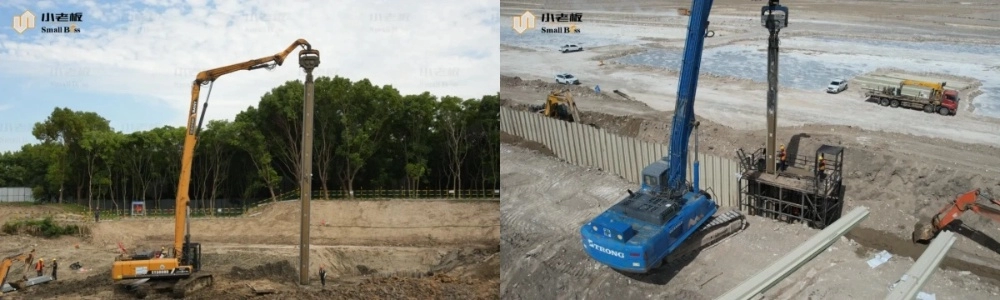
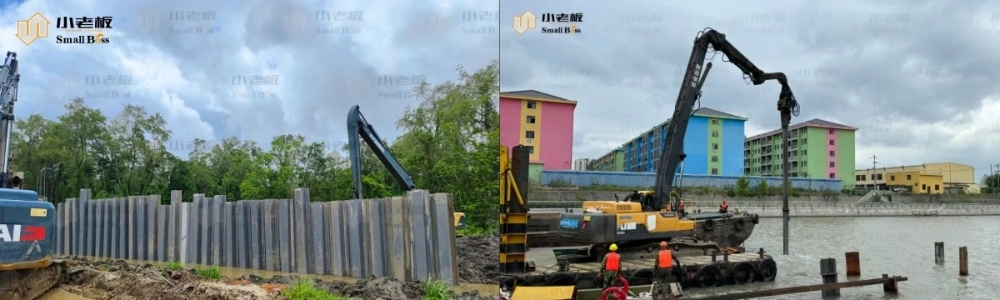
The method: cut a trench 0.7 m wide and 0.3 m deep behind the curb on the upstream side of the crest, drive the piles into it, then backfill with C25 concrete.
The pile does not stand on its own weight, and it does not stand because it is driven deep. It stands because the concrete trench at the top locks it into the crest pavement structure. A 1.2 m cantilever takes the wave, the bending moment travels down to the pile root, and the root is restrained by that trench. It is one continuous load path, and it fails if any link is missing.
The threshold hidden in the details.
The notice contains two more details.
Pile caps are required at the top: 410 mm face width, 85 mm side plate height, 310 mm opening width, 6 mm wall thickness. The 1.2 m above ground takes ultraviolet, temperature swings, wind-blown sand and impact year after year. The cap is both protection and termination.
A sealing waterstop is included. Why does a wave wall need a waterstop? Once overtopping water seeps through the pile joints into the dam body, it is worse than no wall at all: the outside looks sealed while the inside leaks. Interlock plus waterstop forms a double seepage barrier.
One handles durability, the other handles leakage. The tender document puts both in the same paragraph, which says they carry equal weight on this project.
Closing notesIn recent years, existing reservoirs and embankments forced to operate at higher water levels have not been isolated cases. More water has to be stored; when there is nowhere to put it, the level rises; when the level rises, the old dam comes under strain.
The answer to this kind of project is rarely demolition and rebuilding. It is adding a layer to the existing structure, and whether that layer works depends on getting three things right: exposed height, embedment depth and root restraint. Plastic-steel sheet pile is only one of the options, but it has at least proved one point: a pile made of plastic can hold back the waves of a lake.
Small Boss on site