中文
 English
 Español
 Русский
Current position:Home > News & Events > News
CNY 1.607 Billion at Tiaoxi: How 9 m Steel Sheet Piles and 4 m PVC Sheet Piles Split the Work
- The Tiaoxi flood defence works formally started on 17 September, with a budgeted investment of CNY 1.607 billion and a construction period of 36 months. The works cover 7 channels, including the Huancheng He, the Mao'er Gang and the Changdou Gang.
- A single construction lot uses two types of sheet pile: 9 m steel sheet piles for the temporary cofferdam (about 1,410 m) and 4 m PVC sheet piles for the permanent seepage barrier (about 3,602 m).
- Each has a clear and independent role. The steel pile answers “how the works get built”; the PVC pile answers “how water is held back and sealed over the decades that follow”.
- Three criteria separate the choice: the type of load, the service horizon, and the space constraints of urban ground.
- The success of the 3,602 m permanent barrier rests on three things: accurate dimensioning, consistency of series supply, and on-site technical support.
The Tiaoxi rises from the confluence of the East and West Tiaoxi, crosses the built-up area of Huzhou and flows into Lake Taihu. It is the main drainage channel of the Hangjiahu Plain. In August 2026, Typhoon Baihaitun (White Dolphin), together with persistent heavy rainfall, kept the East Tiaoxi above the warning level for a prolonged period. Several dike sections in urban Huzhou had already been classified as Class II and Class III in the earlier safety appraisal, with damage to the dike body and a risk of seepage. Upstream, dikes are being raised to the 200-year return period standard; downstream, the level of Lake Taihu keeps rising. Urban Huzhou, caught in between, has become the weak point of the entire Tiaoxi basin.
The conclusion, first: the hardest part of this project is the raising and thickening of the dikes. The dike runs through consolidated urban ground: municipal streets, residential estates and hospital buildings stand on both banks. There is no room to lay out slopes and no surface area to stockpile soil. That is the central premise behind using two containment and seepage materials at once: this is not a material substitution, it is a division of labour.
The project in numbers: CNY 1.607 billion, 36 months, 7 channels
The Tiaoxi flood defence works formally started on 17 September, with a budgeted investment of CNY 1.607 billion and a total construction period of 36 months. The works cover 7 channels — among them the Huancheng He, the Mao'er Gang and the Changdou Gang — with 2.67 km of new dikes, 35.41 km of dikes raised and thickened, and 26.71 km of channel dredging.
Once complete, urban Huzhou will have a closed 100-year return period defence ring, and the protected core will reach the 200-year standard.
One lot, two sheet piles, completely different jobs
The specialist subcontract notice for the steel sheet pile cofferdam of Lot 1 of the Tiaoxi works contains two work packages at once: execution of the steel sheet pile cofferdam, and installation of the PVC sheet piles. Each material has a defined and independent role, and neither is a substitute for the other.
① 9 m steel sheet pile: temporary cofferdam, removed on completion
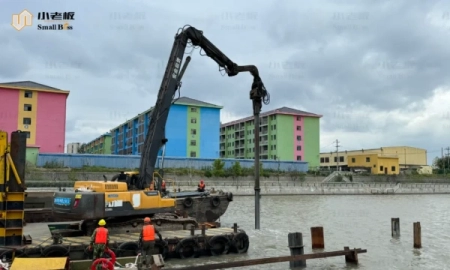
It is driven along the bank over a total length of about 1,410 m, with the cofferdam crest at elevation 3.00 m. The interior is backfilled in layers with quarried granular material, and steel plate is laid over the crest as a working platform. The non-flood-season design flood level is 2.45 m.
The cofferdam's main job is to enclose a dry working area inside the channel and create dry-ground conditions for concreting the dike and for earthworks. It must resist the water level difference and the lateral earth pressure, and satisfy the overturning, sliding and internal flow checks — hence a 9 m length with a long embedment that guarantees stability during construction. The cofferdam is a temporary work with a service period of roughly one year: once the main dike is complete, it is extracted and fully recovered.
② 4 m PVC sheet pile: permanent seepage structure, stays in the works
It is installed along the bank over a total length of about 3,602 m, on the water side of the defence wall. It is the core element of the dike's permanent seepage barrier: it seals the path of water and protects the toe of the dike against erosion, with the same service life as the dike, resisting seepage and current scour for decades.
| Item | 9 m steel sheet pile | 4 m PVC sheet pile |
|---|---|---|
| Role in the works | Temporary cofferdam, removed on completion | Permanent seepage structure, stays in the works |
| Length installed | About 1,410 m | About 3,602 m |
| Pile length | 9 m, with long embedment | 4 m |
| Crest elevation | 3.00 m | — |
| Design flood level | 2.45 m outside the flood season | — |
| Service period | About 12 months; extracted and recovered when the dike is finished | Same as the dike; decades of service |
| Primary function | Enclose a dry working area and satisfy overturning, sliding and internal flow checks | Seal against seepage and protect the dike toe from erosion |
| Installation | Heavy driving equipment; in some sections a driving pontoon | Light equipment; small footprint, low vibration and low noise |
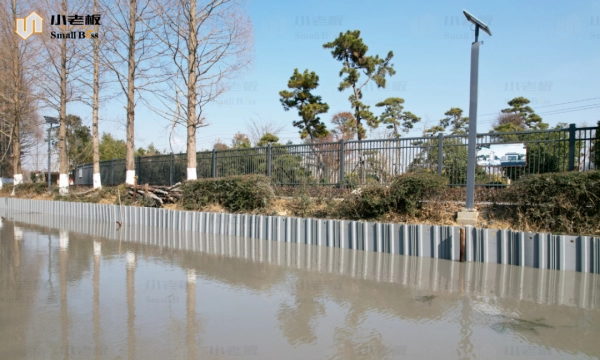
The key distinction: the steel sheet pile solves how the works get built; the PVC sheet pile solves how water is held back and sealed over the decades that follow. Neither material is better or worse: the choice follows the type of load, the service period and the site conditions.
The underlying logic: steel for the temporary, PVC for the permanent
1. Loads of a different nature
The steel cofferdam carries high, concentrated loads of short duration: hydrostatic pressure during the flood season, lateral earth pressure and machine loads all accumulate within a window of a few months. The high strength of steel matches that demand.
The PVC wall carries low but permanent loads: steady water pressure at any time of year, slow seepage and continuous current scour. The instantaneous load is not large, but the demands on long-term corrosion resistance, interlock tightness and dimensional stability are very high. Corrosion resistance is the governing indicator.
2. Different service horizons
The steel sheet pile is a rotating temporary asset: the cofferdam serves for about a year and, when the works finish, it is dismantled and recovered; the steel is reused and dilutes the project cost.
The PVC sheet pile becomes part of the permanent dike structure: it stays submerged and buried at the water–soil interface. Ordinary steel corrodes over time in that environment and needs continuous anti-corrosion maintenance; the PVC sheet pile is corrosion resistant in its own right, does not rust or crack, and its interlock keeps the barrier tight for decades, in line with the service life of the dike.
3. Space constraints in urban ground (the decisive factor on this project)
Driving a 9 m Larsen sheet pile requires heavy equipment and a wide working platform; in some sections a pontoon is needed to work over water. The 4 m PVC sheet pile is installed with light equipment: a small footprint, low vibration and low noise, with no need for large cofferdams with pumping and flow diversion, and it allows section-by-section execution in the low-water season.
On an urban dike in Huzhou that runs alongside residential estates, hospitals and municipal streets, the low-disturbance PVC solution markedly reduces the risk to existing buildings and buried services, and suits dike rehabilitation in constrained urban space.
The 3,602 m permanent barrier: three control points
On the Tiaoxi project, the permanent PVC section (3,602 m) is far larger in volume than the temporary steel cofferdam (1,410 m). The technical, supply and site-control standards for a permanent seepage barrier are far higher than for temporary containment.
Control point 1: dimensioning and selection by calculation first
Pile length, single- or double-row layout and interlock type must be fixed by a dedicated calculation that combines hydrological data, the geotechnical investigation, scour depth and load combinations. Too short a pile leaves a risk of seepage and of the toe being scoured away; too long a pile wastes investment without adding performance. Designing the solution is the first step in making the barrier work.
Control point 2: consistency of series supply
In a continuous wall several kilometres long, the result depends on the consistency of every single pile. Wall thickness, section and interlock dimensions must stay stable within the same batch, and the sealing gaskets and connecting elements must meet the same standard. The supply schedule has to match the pace of the works: one defective interlock opens a seepage path.
Control point 3: on-site technical support through the whole process
Driving PVC sheet piles is not a simple piling operation: equipment selection, driving sequence, definition of the trial parameters and the handling of surprises — boulders, old foundations, complex buried services — require specialist technical staff on site to guarantee a properly engaged interlock and a continuous barrier.
Selection conclusion, and the sections we can take on
The Tiaoxi works, with CNY 1.607 billion of investment, set out a selection principle of real relevance to the water sector: for temporary cofferdams, steel sheet piles are preferred — high strength and recoverable; for the permanent seepage barrier of urban dikes and for bank protection against erosion, PVC sheet piles are preferred — corrosion resistant, low disturbance and tight over the long term. Each material does its own job, and together they make it possible to raise dikes in restricted urban space and to lift the defence standard of the basin.
Solution calculation, stable quality control and on-site technical support are precisely the service model through which Tongxiang SmallBoss Special Plastic Products Co., Ltd. takes its PVC sheet pile projects through to execution. We develop, manufacture and supply PVC sheet piles for construction, and we provide product and technical support to flood defence dikes, channel training, bank seepage control, cofferdams and water body remediation projects, with experience in the Hangjiahu region (Huzhou, Jiaxing and Hangzhou, Zhejiang Province).
Frequently asked questions
Q1. Why does the same project use two types of sheet pile?
Because they do different jobs. The 9 m steel sheet pile forms the temporary cofferdam that allows work in the dry and is removed on completion; the 4 m PVC sheet pile stays in the dike as a permanent seepage structure. They do not compete with each other.
Q2. Could the 9 m steel sheet pile be replaced by PVC?
Not on this project. The cofferdam must resist the water level difference, the lateral earth pressure and machine loads within a short window, and satisfy overturning, sliding and internal flow checks with a long embedment. That is a short-duration, high-intensity demand, suited to a high-strength and recoverable material.
Q3. Why is the PVC sheet pile 4 m and not longer?
Length is not chosen by habit but by calculation: hydrological data, the geotechnical investigation, scour depth and load combinations. Too short a pile leaves a risk of seepage and of the dike toe being destroyed; too long a pile adds cost without adding performance. On this project the solution adopted is 4 m.
Q4. How long does a PVC sheet pile last in a dike?
Its service life is set equal to that of the dike, with decades of service. The material is corrosion resistant in its own right, does not rust or crack, and the interlock keeps the barrier tight over time, which avoids the periodic anti-corrosion maintenance that steel requires at the water–soil interface.
Q5. What does a seepage barrier of more than 3,600 m demand?
Consistency. In a continuous wall, wall thickness, section and interlock dimensions must stay stable within the same batch, with sealing gaskets and connecting elements of the same standard, and with a supply schedule matched to the pace of the works. One defective interlock opens a seepage path along the whole line.
Q6. Can it be installed on an urban dike with little space?
Yes. The PVC sheet pile is installed with light equipment: a small footprint, low vibration and low noise, no need for large cofferdams with pumping and diversion, and section-by-section work in the low-water season. That reduces the risk to existing buildings and buried services.
PVC sheet piles for your permanent seepage barrier
For flood defence dikes, channel training, bank seepage control and cofferdams, we can prepare a selection proposal from your hydrological data and geotechnical investigation.