中文
 English
 Español
 Русский
Current position:Home > News & Events > News
Recirculating Aquaculture Is Reinventing Fish Farming The Water Treatment System Is What Makes It Work
Recirculating Aquaculture Is Reinventing Fish Farming: The Water Treatment System Is What Makes It Work
MBC Mixed Bio-Carrier Technology: The “Key Carrier” That Makes RAS More Efficient
No water changes, no tailwater discharge: once aquaculture moves into a factory, the water treatment system is the heart of the whole plant
1What Is Recirculating Aquaculture?
Put simply, it makes the farming water circulate in a closed or semi-closed system: water discharged from the fish tanks passes through physical filtration, biological purification, disinfection and oxygenation with temperature control, and then returns to the tanks, again and again.
- Water savings above 90%, with a water recycling rate of 95%-99.5%;
- 10-20x higher yield per unit area, with stocking density up to 60-70 kg/m3;
- 90% less medication, enabling drug-free farming throughout the cycle;
- 30%-50% shorter grow-out cycles, with balanced year-round harvests independent of season;
Near-zero tailwater discharge, solving the environmental problem at its source.
2The Water Treatment System: The Heart of the Whole Plant
A complete RAS water treatment system normally consists of five stages, all of which are indispensable:
1.Solids Separation: the Filter Screen
Fish feces and uneaten feed are the main pollution sources. Drum micro-screens, arc screens and settling tanks are commonly used to intercept solid waste. Domestic equipment replaces imported micro-screens with arc screens, which greatly reduces cost and simplifies maintenance.
2.Biological Purification: the Invisible Cleaner
Ammonia nitrogen and nitrite dissolved in the water are highly toxic to fish. Nitrifying bacteria in the biofilter convert them into harmless nitrate. This is the most technically demanding stage of the whole system, and the filter bed needs several weeks to mature before it works reliably.
3.Disinfection: the Security Gate
Combined UV and ozone disinfection kills pathogens in the water and breaks the chain of disease transmission, which is also the precondition for drug-free farming throughout the cycle.
4.Degassing and Oxygenation: the Ventilator
High-density farming places extremely high demands on dissolved oxygen. Nanobubble aeration plates, oxygen cones and liquid oxygen systems push dissolved oxygen to saturation, while degassing tanks remove harmful gases such as carbon dioxide and stabilize the water's acid-base balance.
5.Temperature Control: the Air Conditioner
Thermostatic systems free high-value species such as grouper and mandarin fish from seasonal constraints, enabling off-season farming and staggered market entry, which directly raises product premiums.
A typical process:
3Real Cases: The Numbers Add Up and the Results Are Visible
Mingbo Aquaculture, Laizhou, Shandong
Compared with traditional models, the fully closed recirculating system saves 90% of water, over 60% of energy and reduces tailwater discharge by more than 90%; the achievement was selected as one of Shandong Province's Top Ten Scientific and Technological Innovation Achievements.
Yellow Sea Fisheries Research Institute, Chinese Academy of Fishery Sciences
Technical results have been promoted at more than 30 bases covering over 800,000 m2, spanning nearly 40 marine and freshwater species, with cumulative new sales exceeding RMB 1 billion; system energy consumption is only 1/2 of comparable domestic products and 2/5 of foreign ones.
Chuanshan District, Suining, Sichuan
The output of a nearly 8,000 m3 farming workshop equals 30 times that of a traditional earthen pond, with a water recycling rate above 95% and near-zero tailwater discharge. In 2025 the district produced 7,300 tonnes of aquatic products worth RMB 240 million.
AI Recirculating Aquaculture Base, Liujiang, Guangxi
Twelve intelligent RAS systems monitor dissolved oxygen, pH, ammonia nitrogen and water temperature in real time; when water quality is abnormal, the AI escalates phone alerts level by level, keeping average daily fish mortality below 0.01%.
Farming Base in Xinjiang
From cold-water fish in high-altitude mountain areas to Pacific white shrimp on the Gobi Desert, recirculating technology has made seafood in the place farthest from the sea a reality.
4A Sober Look: Three Thresholds Behind the Opportunity
First, the capital threshold.
A medium-sized RAS system costs millions, and some high-end sensors and intelligent control systems still rely on imports. Fortunately, the localization rate of core equipment has risen above 75% and equipment costs are falling fast, so most well-run projects can achieve payback within 1-2 years.
Second, the technical threshold.
Domesticating the biofilter and matching the parameters of each stage both require a professional operations team. You can afford the equipment but can't run the system is the most common pitfall for beginners, so choosing a supplier with full design, construction, training and O&M capability is critical.
Third, the operational threshold.
High density means high energy input, and electricity is one of the largest operating costs; blindly raising stocking density to chase output may exceed the system's purification capacity. Stability above all else is the first rule of RAS operation.
01The Bottleneck in Recirculating Aquaculture: Ammonia Nitrogen and Nitrite Removal
In recent years, industrial recirculating aquaculture systems (RAS) have become a key direction for aquaculture upgrading thanks to their water-saving, environmentally friendly and controllable advantages. However, under high-density farming, excreta and uneaten feed decompose in the water, pushing total ammonia nitrogen higher. If the highly toxic free ammonia and the nitrite are not promptly converted into low-toxicity nitrate in the biofilter, they threaten fish and shrimp health and can cause large-scale mortality. Removing ammonia nitrogen and nitrite at low cost is a hurdle every RAS designer must clear.
In the biological treatment stage, the media is the heart of the entire system. The performance, mixing ratio and cost of the media directly determine the treatment efficiency and operating economics of the biofilter.
02MBC Mixed Bio-Carrier Technology: The Optimal Balance of Performance and Cost
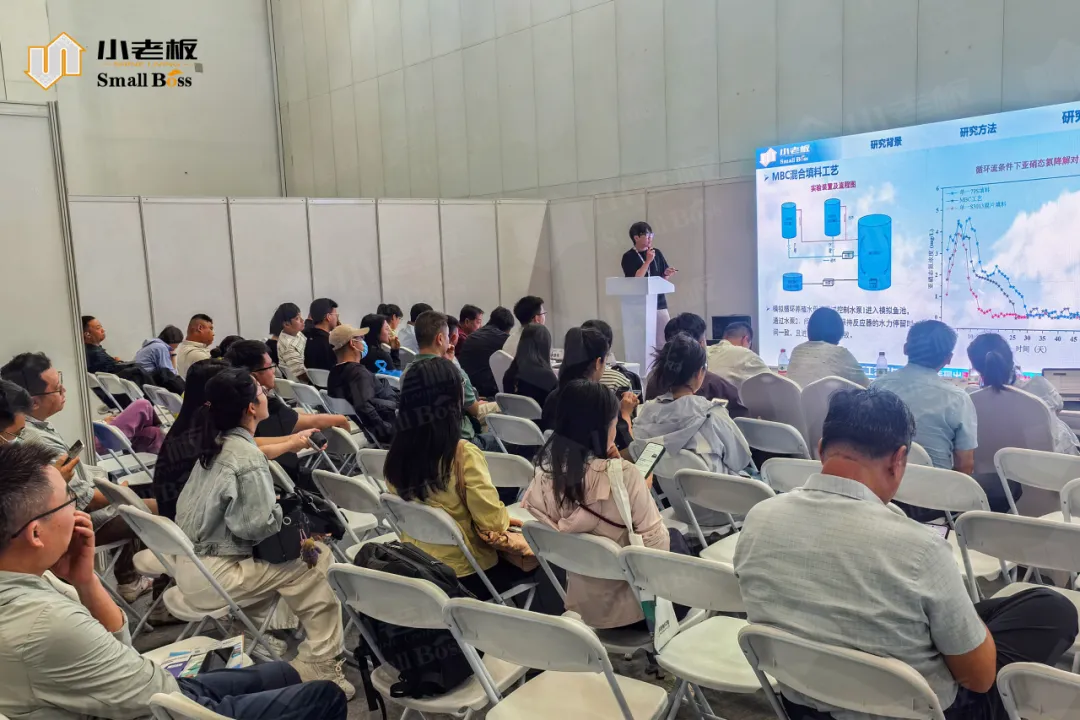
In his talk, Engineer Pan Feng went straight to the dilemma the industry faces when choosing media:
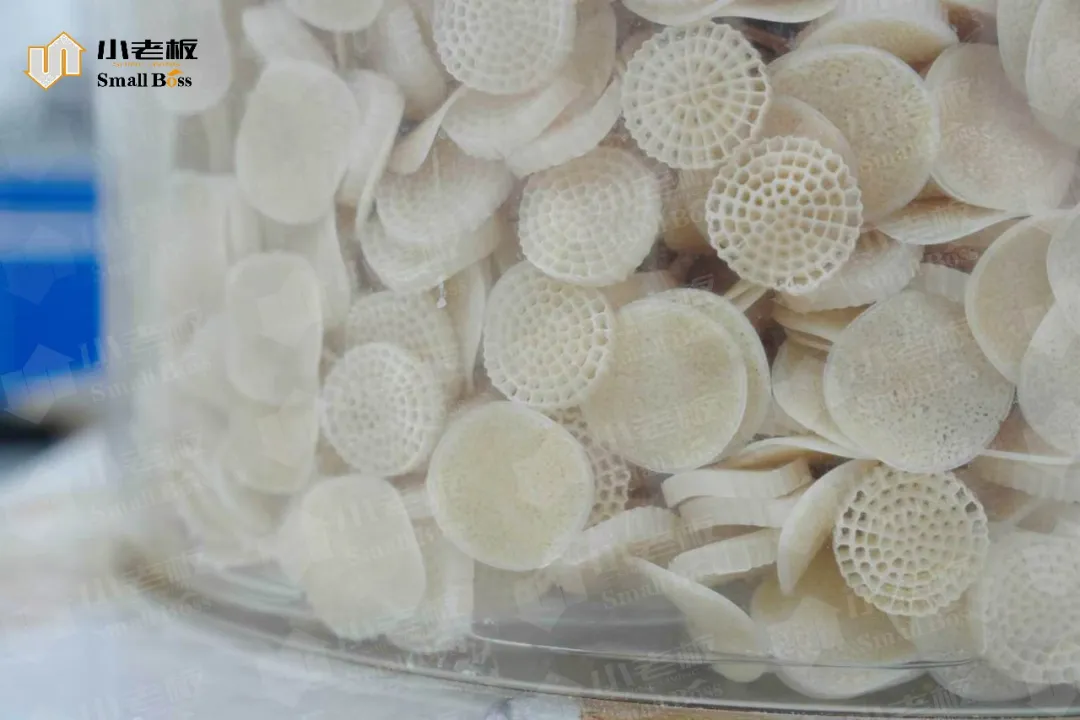
- Membrane (sheet) media offer a large specific surface area and good treatment performance, but they are expensive, prone to clogging, and their real-world results are often questioned;
- Single conventional media are cost-controllable compared with membrane media, but nitrite degradation is slow and system start-up takes longer, which affects the farming schedule.
Is there a solution that gets close to the treatment performance of pure membrane media while cutting cost substantially?
The answer from SmallBoss is MBC mixed bio-carrier technology (Mixing Bio-carrier).
Engineer Pan Feng explained that the SmallBoss R&D team ran extensive comparative trials, mixing PE79S media with membrane media at different ratios, and ultimately identified the optimal blend. The test data showed:
- Ammonia nitrogen degradation: mixed media performed almost identically to single-type media;
- Nitrite degradation: every group with added membrane media improved markedly, with the nitrite peak arriving 3-5 days earlier than with pure 79S media;
- Overall performance: degradation performance close to that of pure membrane media, while media cost is significantly lower.
This means RAS systems can substantially reduce biofilter investment without sacrificing treatment performance, get through the start-up period faster, and bring production into stable operation sooner. That is why MBC technology has become the key carrier for improving the efficiency of recirculating aquaculture systems.
03More Than 20 Years in MBBR: A Media Specialist That Lets the Data Speak
Tongxiang SmallBoss Special Plastic Products Co., Ltd. took root in Tongxiang in 1992. In three decades it has moved from conventional plastics to special environmentally friendly plastics. The company now has more than 350 employees, with R&D staff above 30%, runs more than 150 production lines, and exports to more than 100 countries and regions.
As a national little giant specialized and sophisticated enterprise, Tongxiang SmallBoss currently holds 73 domestic patents and 4 international patents, participates in MBBR industry standard setting, and led the drafting of the national MBBR biofilm formation standard. In 2026 it also won the Top Ten Sci-Tech Innovation Awards of China's Aquatic Products Business Card.
04Conclusion
Engineer Pan Feng's invitation to speak at the Beijing Water Expo forum is both industry recognition of SmallBoss's technical strength and a clear sign of the company's determined shift from media manufacturer to water treatment biological plant service provider.